Ad Astra Per Oklahoma
Published March 2026
By Nathan Gunter | 19 min read
Another hot night. Prairie summers—so unforgiving. The family pulls cots into the backyard, as they do when the summer heat makes it hard to sleep inside, where there is no air conditioning. Under the sprawl of stars, a young boy sidles up to his father, who points out the constellations. The moon is a luminant sliver casting a pall on the western Oklahoma family. The boy looks up from his Oklahoma backyard at the silver wedge and wonders if anyone will ever touch it.
The next day, young Tom Stafford hears a noise and glances upward. The country's first transcontinental airline route mirrors Route 66, which passes just a couple of blocks south of his home, and above his head soars a silver DC-3 on its way to Amarillo and points west. It's a daily sight, but as he watches it cut a swath through the atmosphere, his imagination takes flight alongside it.
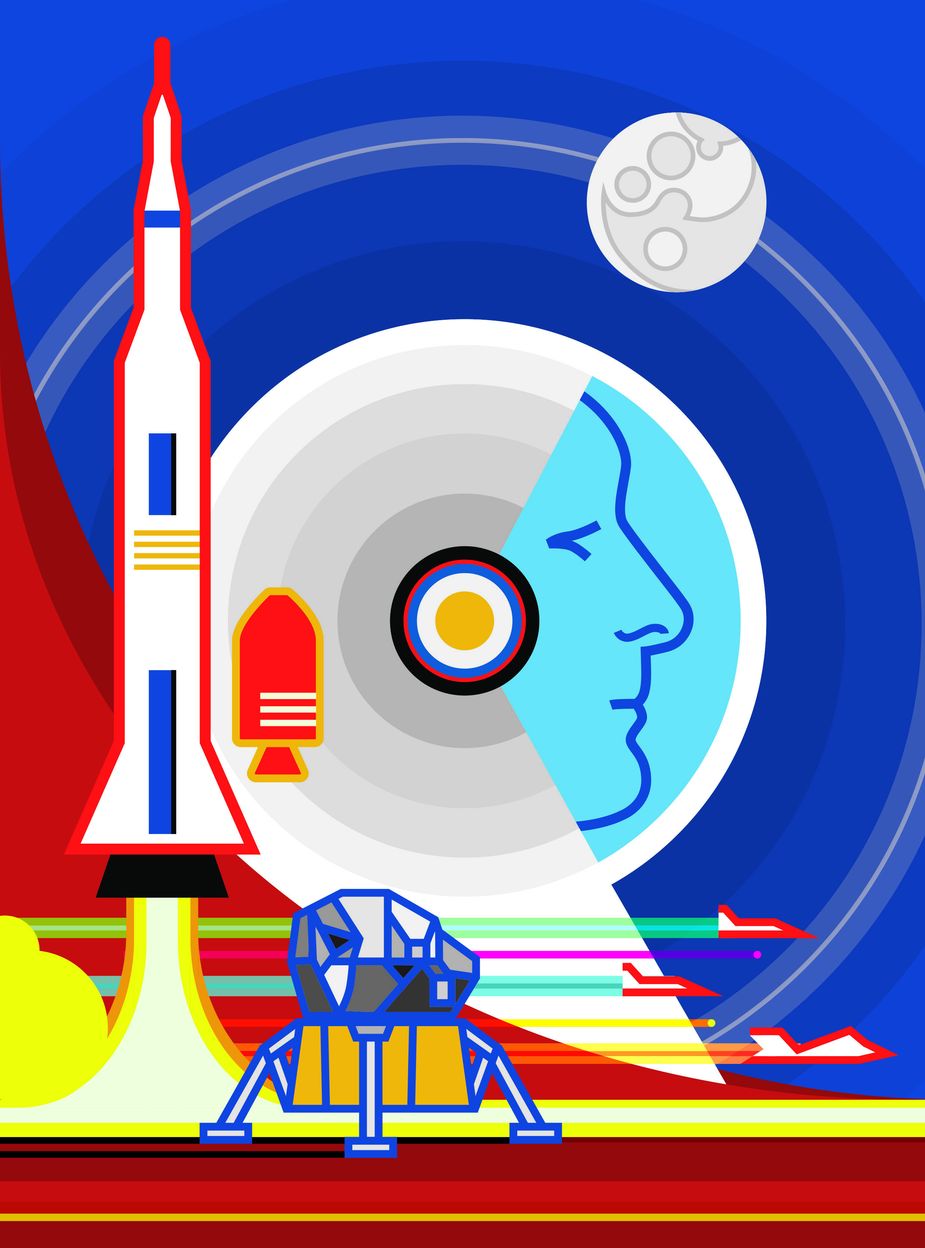
Illustration by Christopher Lee
Thomas Patten Stafford was born in Weatherford on September 17, 1930, the son of a dentist and a former teacher, and from an early age, a sense of adventure and love of adrenaline beckoned him. At age four, visiting a farm near May, he climbed an eighty-five-foot windmill—one of the world's tallest at the time—to the top.
"I took one look at that thing and headed right for it, my little legs churning as fast as they could," Stafford wrote in his autobiography, We Have Capture. "I was up that ladder and all the way to the platform at the top—eight stories up—before my parents noticed I was gone."
As he grew, Tom only became bolder. With World War II in full swing, pilots undergoing Air Corps training at El Reno practiced takeoffs and landings at the Weatherford airport, and he would ride his bicycle out to watch. He got a paper route to fund his model airplane hobby. At fourteen, a teacher arranged for him to take his first flight—on a yellow two-seater Piper Cub. Tom was hooked. Another teacher handed off her science section of the Sunday New York Times, where he read about warplanes and heroic test pilots like Chuck Yeager. As high school ended, Tom earned a nomination to the U.S. Naval Academy.
But before he could depart, tragedy struck: His father, Thomas Sabert Stafford, died of skin cancer. Only a few days after the funeral, Tom Stafford left Weatherford behind for Annapolis.
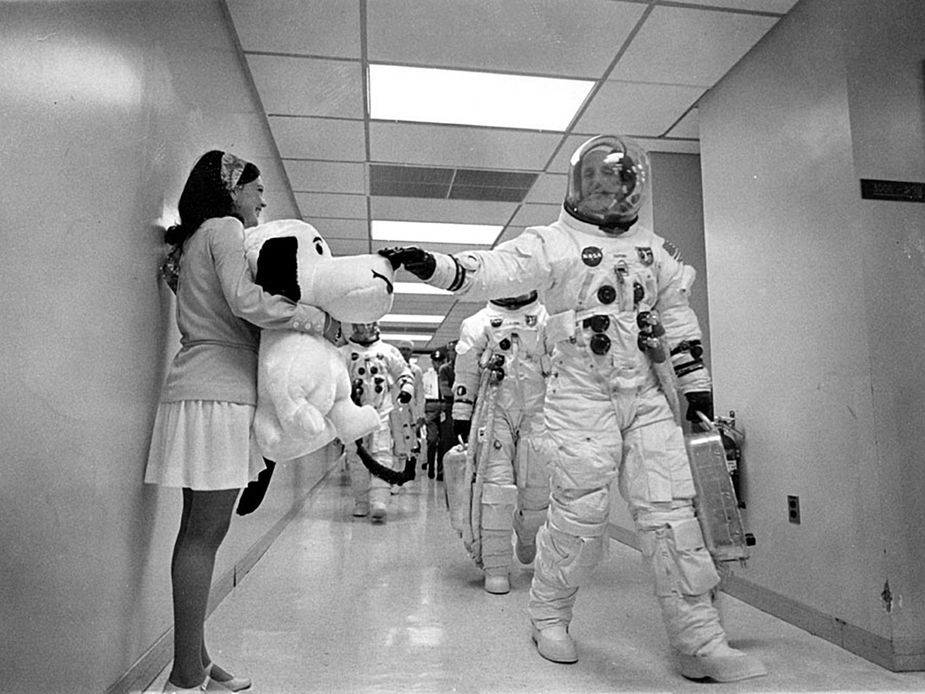
Stafford pats a plush Snoopy—the lunar module’s nickname—on the way to the Apollo 10 launch pad. Peanuts creator Charles M. Schulz created special artwork for the mission. Photo courtesy NASA
By the end of his first year at the Naval Academy, Tom was in the top 20 percent of his class. By the end of his second, he was in the top 10. On an excursion in a Navy SNJ trainer that summer, he saw where his future lay.
"[e SNJ trainer] could pull Gs and do aerobatics, and some of my classmates came back with their barf bags full. Not me, though," he wrote. "The rides left me more determined than ever to become a pilot."
On June 3, 1952, Stafford was commissioned a second lieutenant in the Air Force, which did not have an academy of its own at the time. By September of the next year, he'd earned his silver wings and was married to Faye Shoemaker, a girl from Weatherford.
And thus began the itinerant life of a military family. The Staffords' daughter Dionne was born at Ellsworth Air Force Base in South Dakota in 1954, and in 1957, they welcomed daughter Karin at Hahn Air Base in Germany.
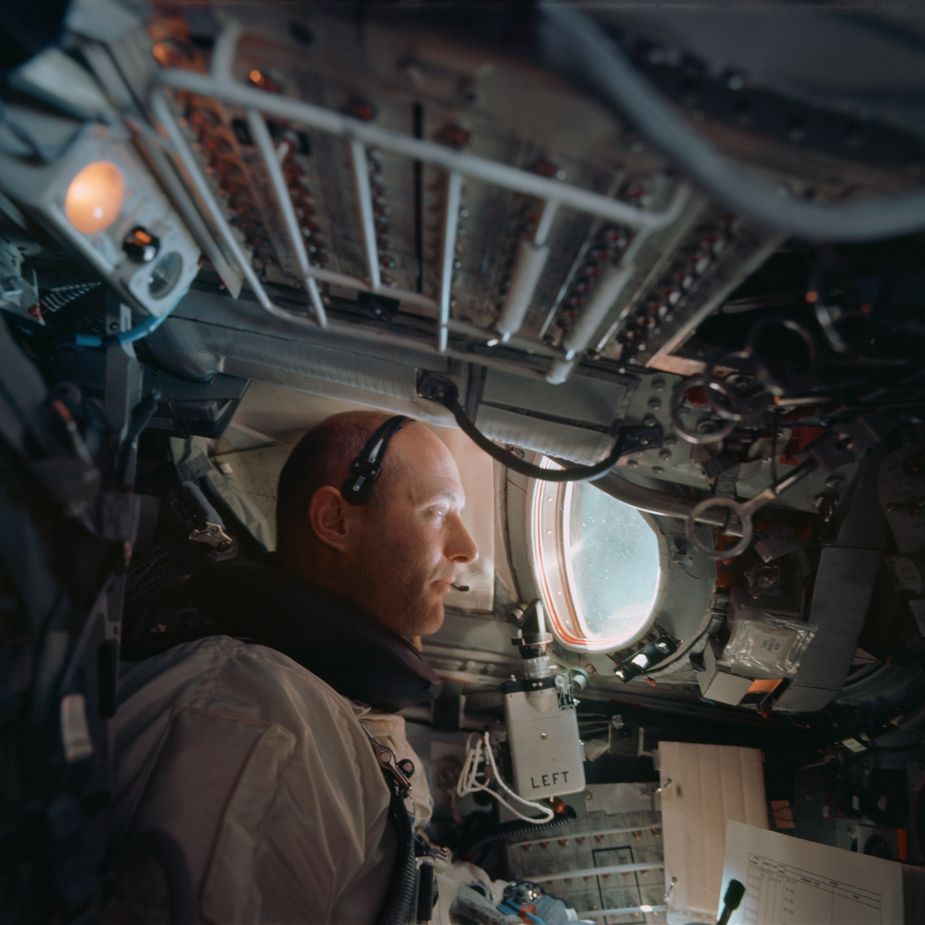
Astronaut Eugene Cernan captured this photo of Thomas P. Stafford on the Gemini 9A spaceflight. It was the world’s twenty-third manned trip to Earth orbit. Photo courtesy NASA
By the early 1960s, Tom had graduated from the Air Force's Test Pilot Flight School and was looking for something new. NASA's astronaut program had begun with the selection of the Mercury crews. However, at six feet tall, he couldn't fit inside the capsule.
But with the impending launch of the Gemini program, which included a bigger crew compartment, he heard from Donald "Deke" Slayton at NASA: "Are you still interested in the astronaut group?"
So in October 1962, Tom, Faye, and the girls moved into an apartment near Ellington Air Force Base in Houston, where their neighbors included future Apollo astronauts Neil Armstrong and John W. Young and their families.
Years of training and hard work followed before, at 8:37 a.m. on December 15, 1965, Tom Stafford sat atop a Titan rocket on Pad 19 at Cape Canaveral when it lifted him and Walter M. "Wally" Schirra Jr. into space for the Gemini 6A mission, which was to rendezvous in orbit with Gemini 7, carrying astronauts Jim Lovell and Frank Borman.
The rendezvous maneuver was essential to the then-fledgling Apollo program's plans for a lunar landing, and Stafford—who was known around NASA for his quick math skills and having worked out many of the calculations for the meeting—piloted Gemini 6A to an altitude of more than 160 miles to come within, at one point, only a couple of feet of Gemini 7. The following day, December 16, the Gemini 6A capsule splashed down in the Atlantic Ocean.
"I was dehydrated, tired, but happy as hell," Stafford wrote. "We had proved that rendezvous would work, one of the key goals of the Gemini program and a major step toward landing on the moon."
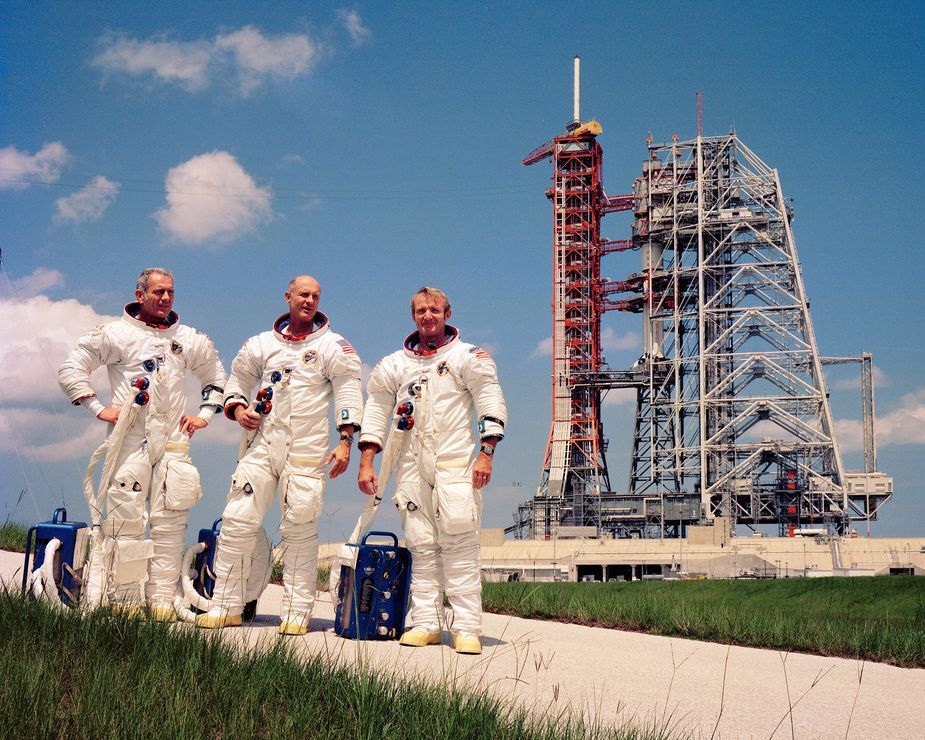
Donald “Deke” Slayton, Thomas P. Stafford, and Vance Brand after the Countdown Demonstration Test—a final dress rehearsal for the Apollo-Soyuz Test Project. Photo courtesy NASA
Tom Stafford could have been the first man on the moon.
By 1969, having piloted Gemini 6A and achieved another rendezvous with Gemini 9, Tom had been selected as the commander of Apollo 10. And with the success of the program's previous flight in March of that year, talk at NASA turned to moving up the lunar landing. But ever the tactical, pragmatic thinker, Stafford held off.
"Gene Cernan and I would have loved to be the first astronauts to walk on the Moon," he wrote. "But there were still too many unknowns to make it feasible for our flight. . . . No. The Apollo 10 ‘close encounter’ was necessary if Apollo 11 were going to make a landing."
So on May 18, 1969, Stafford, Cernan, and Young lifted off atop a Saturn V rocket carrying Charlie Brown—the Command and Service Module—and Snoopy, the lunar lander. By May 20, they were more than 150,000 miles away from home and headed for lunar orbit and the Moon's far side.
"It was early morning, lunar time, and the colors ran from white to black to gray to light tan to very pale yellow, with slightly reddish peaks on the craters and mountain tops," he wrote. "Then we saw our first Earthrise, a little blue and white ball, two-thirds the size of a baseball, that popped up from the horizon very quickly. . . . 'Houston,' I said, 'tell the world we have arrived.'"
Apollo 10 orbited the Moon thirty-one times—at one point Stafford piloting them as low as nine miles above the surface—successfully jettisoned Snoopy, and orbited for more than sixty hours before a two-minute, forty-four-second burn sent it on its way home. At one point, the capsule reached a speed of 24,791.4 nautical miles per hour—the fastest any humans have ever flown.
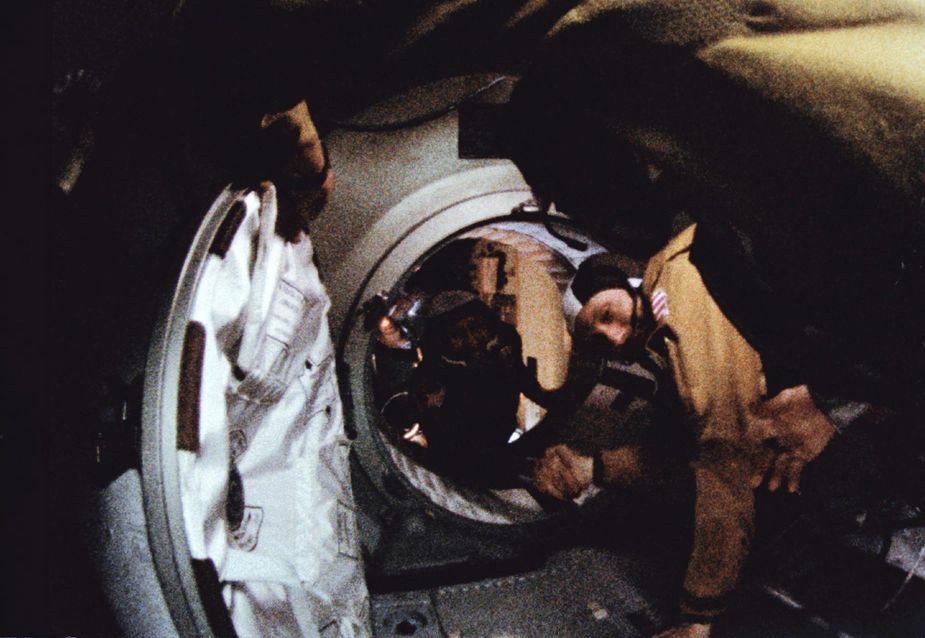
Stafford and cosmonaut Aleksei A. Leonov shake hands in space during the Apollo-Soyuz Test Project. Photo courtesy NASA
Tom Stafford served as Chief of NASA's Astronaut Office until 1971. But with the success of Apollo 11 and America's unchallenged victory in the Space Race, things had shifted. Once fierce competitors, Washington and Moscow were beginning to discuss a rendezvous mission. On May 24, 1972, President Nixon and Soviet President Aleksei Kosygin signed an agreement authorizing the Apollo-Soyuz Test Project.
"I got excited about flying the American side of the mission," Stafford wrote. "With my three previous flights, having flown more rendezvous than any other astronaut or cosmonaut, I knew I would have a good chance at the assignment."
Stafford learned Russian—his accented pronunciation was jokingly referred to as "Oklahomsky"—and became a frequent visitor to the Soviet Union, even securing a rare visit to the USSR's space operations at Baikonur. He befriended Aleksei A. Leonov, the cosmonaut commanding the Soviet side of the mission—a close friendship that lasted the rest of their lives.
Years of diplomacy and training on Apollo and Soyuz systems followed, and at several key moments, it seemed the project might not fly at all. But on July 15, 1975, the sixteen-ton Saturn 1B rocket and capsule launched from Florida. Two days later, the two craft approached each other 130 miles above France.
Three hours later, the hatches were open, and as the moment was broadcast to millions all over the world, Stafford and Leonov floated toward each other.
"Ah, glad to see you!" Leonov called.
"Ochen rad,” Tom replied in his Oklahomasky Russian—"Very good."
It was a crucial moment in the Cold War, a precursor of the global cooperation that would produce the International Space Station (ISS). The two craft were linked for nearly two days.
"It’s amazing to think that two diametrically opposed countries with different systems and cultures, essentially ready to destroy each other, can somehow cooperate and do this highly technical, complicated mission," Asif Siddiqi, a professor of history at Fordham University and an expert on Russian space history, told The New York Times in 2025 on the rendezvous' fiftieth anniversary.
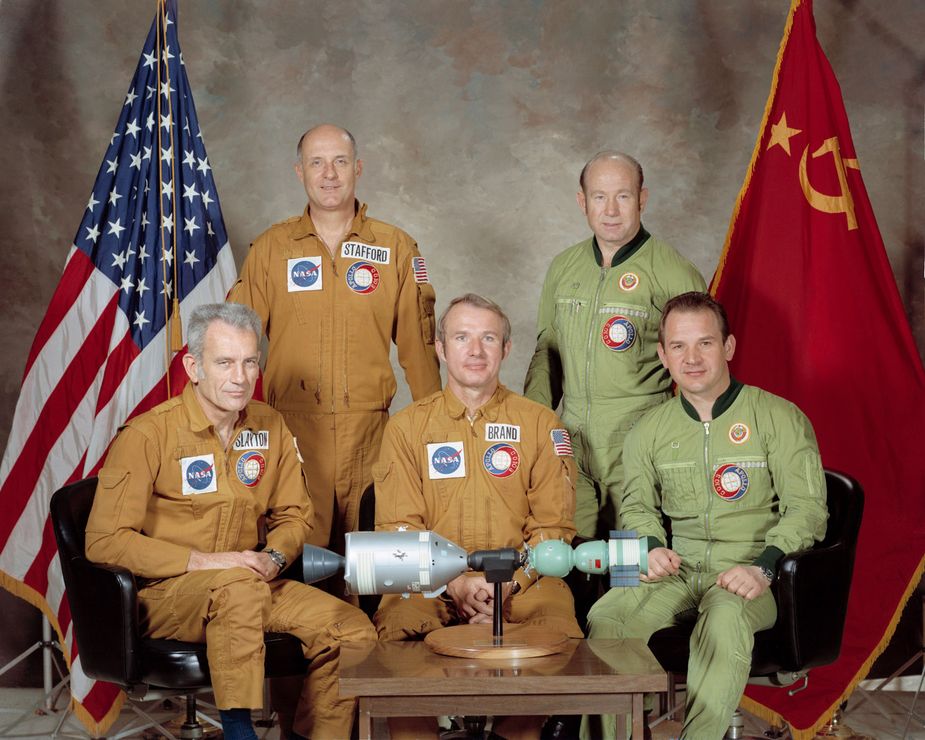
The joint crew for the Apollo Soyuz Test Project. Clockwise from top left: Astronaut Thomas P. Stafford; Cosmonaut Aleksey A. Leonov, commander of the Soviet crew; Cosmonaut Valeriy N. Kubasov; Astronaut Vance D. Brand; and Astronaut Donald K. Slayton. Photo courtesy NASA
Apollo-Soyuz was the last manned American spaceflight until the launch of the Shuttle in 1981. Just before the mission, Stafford was offered command of the Air Force Flight Test Center, where he oversaw operations at Edwards Air Force Base and served as commanding general of the famed Area 51 in Nevada, known in the military as Dreamland.
"There were no alien bodies stashed at Dreamland, only vehicles we wished to fly and test in relative privacy," Stafford wrote of the legendary installation.
During his time at Dreamland, Stafford was crucial in pushing the funding and development of stealth technology. He retired from the military in 1979 but never strayed far from NASA: He was integral in helping the Shuttle get off the ground and played a role in the investigation of the Challenger disaster in 1986. And he consulted extensively on the design and creation of the ISS. But he never forgot his hometown.
"Most astronauts, the moment they became famous, they stopped going home," says Phillip Fitzsimmons, university archivist and special collections librarian at Southwestern Oklahoma State University in Weatherford. "He was always here and very generous. He never stopped contributing to Weatherford."
The astronaut funded a group of students known as Stafford Scholars, who now assist Fitzsimmons in maintaining his archives here. And in 1993, the Weatherford Airport set up a couple of display cases with some of Stafford's donated artifacts from his childhood, his career, and his time in space. The Stafford Air & Space Museum was born.
More than three decades later, that same airport is home to a 75,000-square-foot, Smithsonian-affiliated facility that is one of Oklahoma's greatest museum experiences. Several of Stafford's flight suits are on display here, as are two space-flown capsules: Skylab 4 and the Gemini 6A that Stafford flew into Earth orbit in 1965. There’s also a Lockheed F-117A Nighthawk Stealth Fighter, a lunar module simulator, and tucked away in a small display case, a piece of the left wing and propeller from the Wright Flyer that Neil Armstrong took to the Moon with him. Stafford himself was integral in building the museum.
"Up until he passed, every week, he was just a phone call away, and usually it was him calling us," says Julie Lenius, the museum’s executive director. "He was very active in every element of this museum and the thought that's gone into what we are today."
The Stafford Air & Space Museum's main mission, however, is to reach the kids who, just like a young Tom Stafford, look up at western Oklahoma skies and dream of what they might become. Among its many offerings, the museum partners with the Department of Defense on its Starbase program, offering STEM courses to fifth graders from dozens of school districts every year.
"The driving force behind all this was those next generations," Lenius says. "We want to ensure they are pushing the boundaries and seeing how much higher and farther and faster they can go."
In late 2026 or early 2027, the museum is set to expand its STEM education center with a suite of interactive activities. A new outdoor park mimics planetary surfaces including the Moon and Mars, and in a new events center, the Smithsonian's life-size replica of the sixty-six foot Apollo-Soyuz capsule, on a long-term loan from the National Air and Space Museum, will fill one wall.
And on the other end of town, as motorists mosey down Route 66—AKA Weatherford’s Main Street—they'll see a thirty-foot astronaut staring at them from the roadside. They'll stop, take a selfie, and look around. Just a few blocks north on what is now Tom Stafford Avenue, a pocket park sits on the site of the general's childhood home. Stafford, who died in 2024, never stopped embracing his hometown—and now, it's widening its embrace even further.
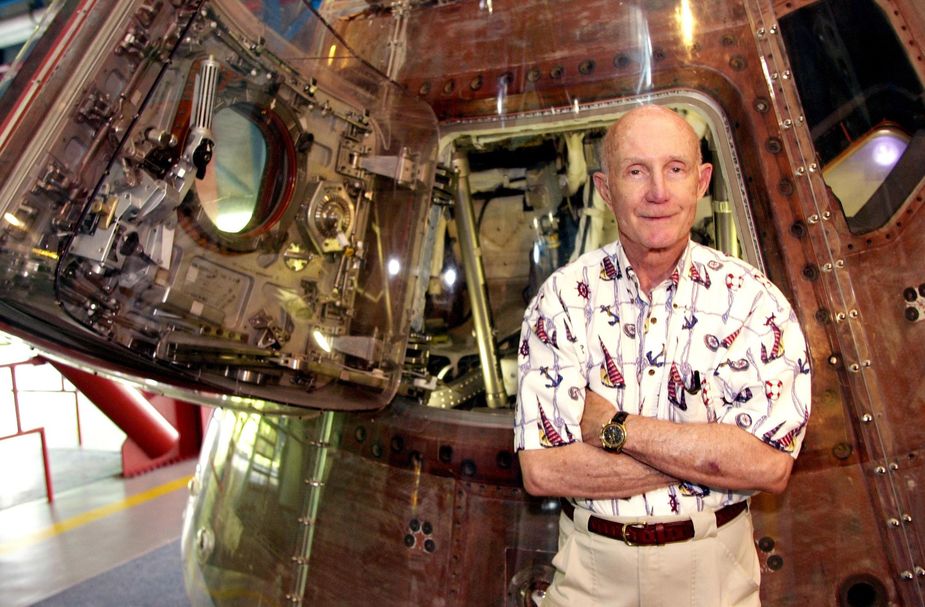
Stafford in 2002 next to the module he flew as the commander of the Apollo-Soyuz Test Project, which then was displayed at the Kennedy Space Center. Photo courtesy NASA
"General Stafford has left a legacy here in Weatherford," says Weatherford Mayor Mike Brown. "It felt like 'The Space City on Route 66' was different than what everybody else was doing."
The ISS will be deorbited in 2031. It'll come down in the Pacific Ocean, and no doubt a young kid in Weatherford will watch—perhaps from the Stafford Museum—as an era of international cooperation in space ends, one inaugurated by someone much like themselves. What will they see when they look up into that same night sky? What will they dream of becoming?
The General Thomas P. Stafford Archives at SWOSU
Some materials also are viewable online.
Al Harris Library
100 West Campus Drive in Weatherford
(580) 774-7024
stafford.swosu.edu
Weatherford Route 66 Spaceman
Main Street and Broadway Street