String Fling
Published April 2026
By Karlie Ybarra | 6 min read
As technology encourages isolation and efficiency over connection and creation, how is it possible to continue to express that ineffable thing called humanity? There likely are as many different answers to that query as there are people on the planet, but the fact that researchers discovered a flute carved from a cave bear femur as early as 60,000 years ago indicates that the need to make music is interwoven with whatever life force animates us.
Kent Schoonover certainly gets animated when he talks about the creation of his Schoonover Resophonic Guitars. He made his first one in 1992, and he’s made around 120 in the years since then. But long before he crafted his own instruments, he was playing them with his family.
“The music came first,” Schoonover says. “My dad was a fiddle player, and his dad was a musician. His granddad was a fiddle player. Ever since he was little, my brother was a Dobro player, and I grew up playing the banjo.”
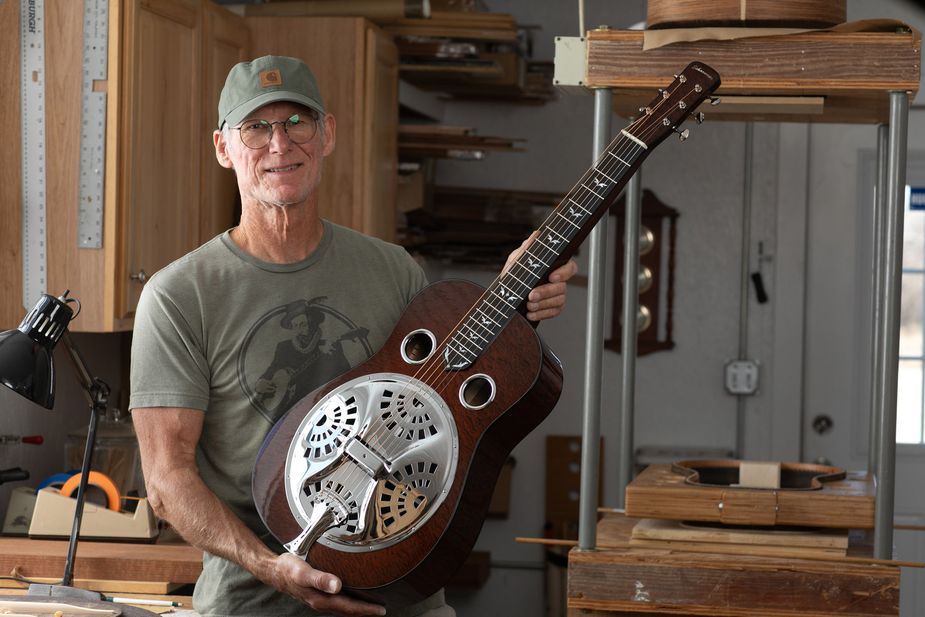
Kent Schoonover crafted this guitar from African Sapele wood. It’s the first one he made for himself since he started three decades ago. Photo by Brent Fuchs
Starting in 1969, the Schoonovers would make an annual pilgrimage from Lone Grove to Hugo for the Bill Grant Bluegrass Festival.
“It was amazing,” he says. “There were 16,000 people there, and all these bluegrass greats came. People would gather in groups and under trees and play all day and all night long. My brother and I grew up down there, and that’s when the hooks got into me.”
Schoonover never stopped playing, but he did find other passions to occupy his hands.
“I love working with wood,” he says. “I’m just moved by a piece of wood.”
When Schoonover turns over a raw plank in his hands, waxing poetic on the symmetry of the grain, it’s obvious he isn’t exaggerating. And wood seems to love him back. He’s crafted rocking chairs and other heirloom pieces that will exist long after he does.
But it’s guitars Schoonover has built his Springer workshop around. There, he crafts extra durable machines—thanks to an internal structural support cone he invented that offsets the 220 pounds of pressure the strings apply to the body—for fellow music lovers from around the world, including a rosewood and cedar beauty he’s currently working on for Woody Guthrie’s grandson. Fans of bluegrass likely have heard his work, especially during a Blue Highway set. Both he and his wife Tammie still get excited every time they hear the signature Schoonover sound resonating over the radio.
That excitement must help keep Schoonover going, because it isn’t a profitable enterprise. Travis Williams makes acoustic guitars at his own shop in nearby Ardmore, and he barely clears expenses from his pieces despite prices that start at $4,000 to $5,000.
“Kent and I laugh about how hard it is to make any money doing it,” he says. “It’s not about the money—it’s about the passion and the music.”
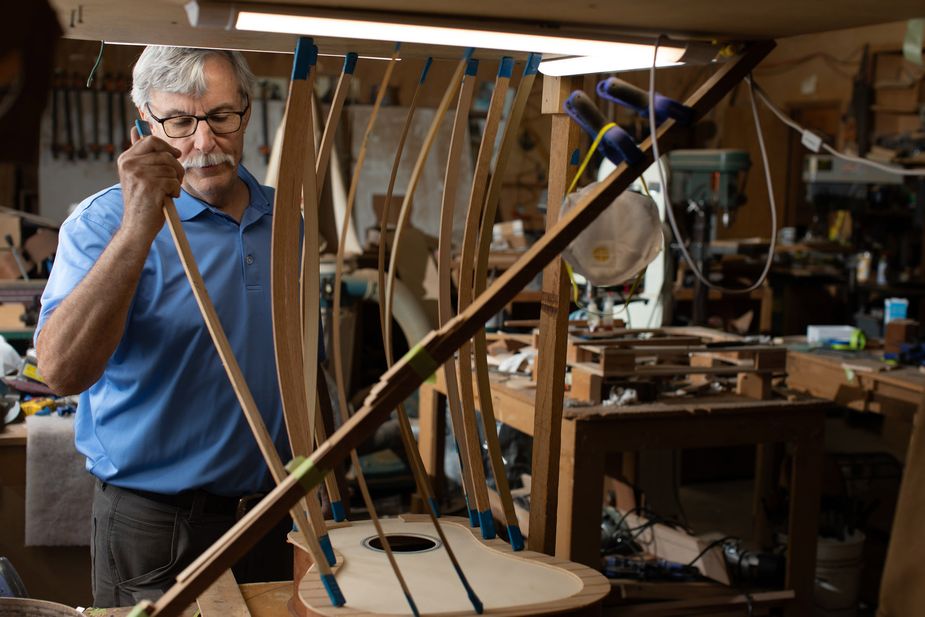
Travis Williams works on multiple batches of parts at once, but he completes about two-and-a-half instruments a year. Photo by Brent Fuchs
Williams started playing guitar around age fourteen. As an adult, his day job was as a carpenter and a cabinet maker, so in 2003, he decided if he was going to become a better player, he should make his own guitar.
He’s only made about sixty instruments in the ensuing years, but that speaks to the craftsmanship, time, and energy they require. Most guitars made today, even the good ones, are mass-produced, so Williams’ stand out on the world stage. He met a Japanese journalist at a show in Nashville, and a month later, the Tokyo boutique Blue-G wanted to buy one of Williams’ guitars.
“There’s a big market worldwide for guitars made in North America by guys like me,” he says. “Can you believe that?”
Both Williams’ and Schoonover’s hands perhaps answer that question best. They are large and strong but marked with the inevitable scars of the craftsman. They may injure themselves occasionally, but that’s the cost of creation—of transforming raw materials into a connection to music, to tradition, and to their own humanity.