Going to the Dogs
Published April 2022
By Shane Bevel | Photos by Shane Bevel | 10 min read
It’s an art, really. I often tell people that, and they don’t believe me. Sometimes, the response is a blank stare of misunderstanding. Sometimes, it’s an eye roll. Sometimes, they just laugh it off like I don’t mean it. But I do. It’s the most honest thing I can say: Living with bird dogs is an art.
There is no real science to it, of course. The existence of science would imply that anyone could read a book and understand both the mechanics and the reasoning behind the choice. They could study hard and gain an appreciation of why we do what we do. But such a resource doesn’t really exist. Until you experience the life of what George Bird Evans called “we who shoot,” there simply is no true comprehension.
For instance, when the editor of this fine publication first asked me to wax poetic about the sporting life and living with bird dogs, I laughed. It was, after all, May. And May is no time to speak fondly of bird dogs. The hunting season is but a dried-up flake of a memory; nothing more remaining than a few photos and possibly a sand burr or two in an orphaned wool sock. Even the championship field trials, with all their pomp and circumstance, are over for the year.
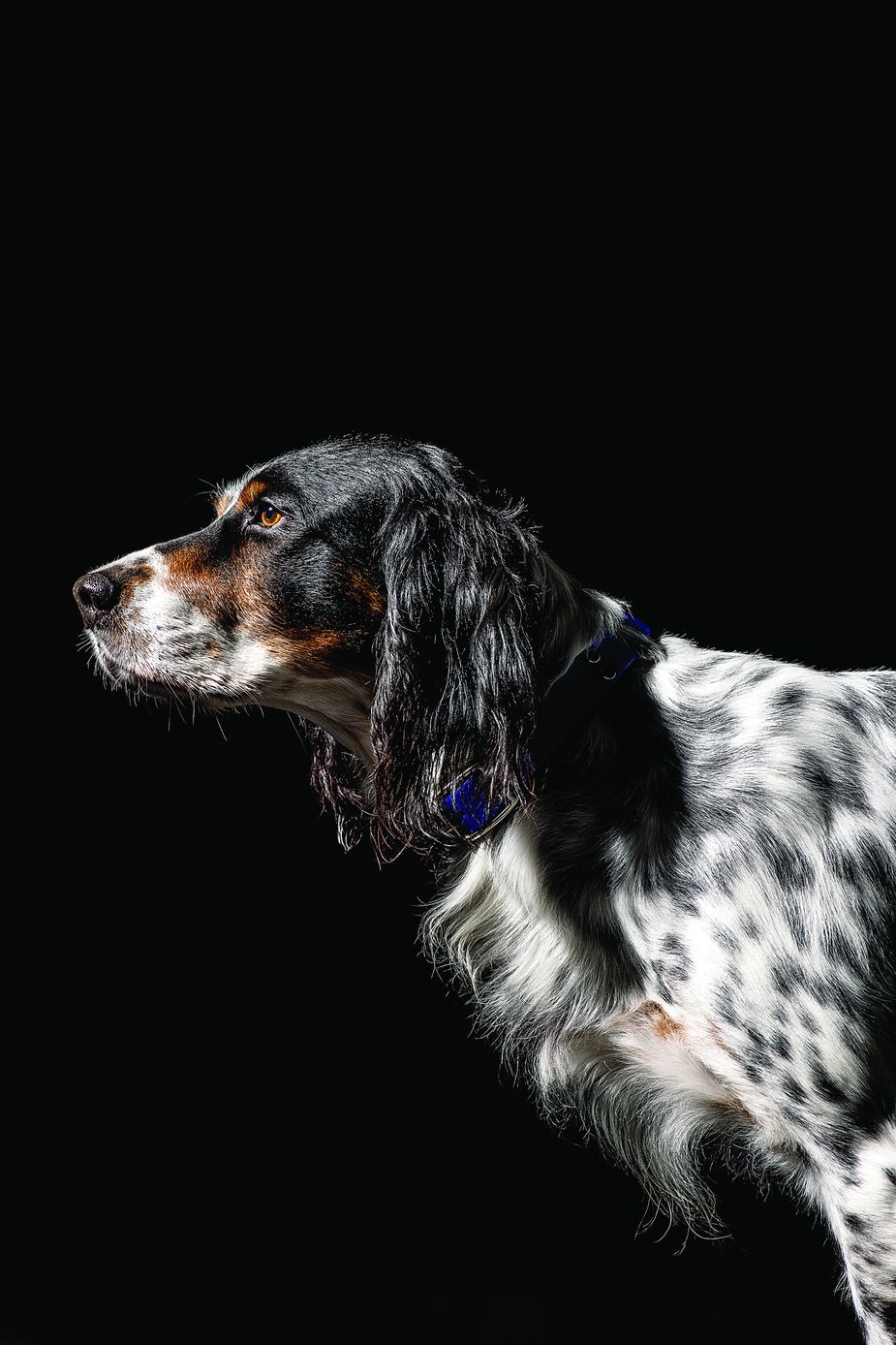
Shane Bevel photographed his Llewellin setter Bayou—whose registered name is Bevel’s Royal Bayou—in his Tulsa studio.
The everyday owner of a fine bird dog is now faced with two realities: Either months of payments to a trainer or boarder or a summer of misery and regret. In the summer months, bird dogs can be terrible housemates. They are irritating, impatient, and insistent. They eat your daughter’s sparkly headbands and then leave them filthy on the freshly mowed lawn. The piles stand and wait for you like glittery cairns marking the path to remind you of each step you chose to take down this inane path to your own insanity.
Bird dogs lay on the kitchen floor panting and slobbering, trying in vain to cool themselves after having dug a newly planted shrub out of the garden. They chase cats. Dig for moles. Bark at the neighbors. Climb fences. Terrorize squirrels and other small backyard creatures. Kill young rabbits and devour only the newest, most expensive leather goods. The only real solution is exercise, which is good for your mental health and their continued well-being in the household. But within a month or so of the onset of summer, it’s simply too hot to safely run them enough to keep the edge off.
For a sportsman with a young dog, the out is evident: summer camp. Yes, send that pup north with others on the storied string of a famous trainer in Nebraska, Montana, or the Dakotas. Maybe you even slide away for a week in August to visit. Meanwhile, you relax and enjoy the peace and quiet of your own home. Make a call once a week to check on them and hear their progress and then simply wait for cooler temps to arrive.
But in my home, for better or worse and often both, dogs are family members. They sleep on our floors and illicitly dine from our tables. They serve as heated pillows to our children while destroying our most prized belongings. So we who practice the art soldier on through the heat.
Then, sometime in September, things begin to change. The mornings are cooler. The humidity drops. We suffer through the first field trial or two in still-brutal heat, watching the dogs closely for signs of exhaustion and dunking them in horse troughs of cool green water while praying that somehow, they can find a single bird in fields of still-growing grass and ripening ragweed. Yet with every five-degree drop in temperature, dogs and men begin to look and feel exponentially better. Spirits are up. Nuisance is down.
Finally, November shows its face. The first freeze knocks back the weeds and improves scenting conditions. The leaves are off the trees, and the birds, once scattered to the four corners, have gathered into their coveys. At some point, the dreams of the offseason become a reality. You step out into the open country and turn loose of the collar. The dog is off like a shot, cruising across the landscape like a brush across a painting. Gliding over hills and through draws, covering the territory with a speed and efficiency bordering on the unreal. The ground rumbles as he passes you and goes out for yet another cast, turning his head as he moves as if to say, “Let’s go, friend. We made it.”
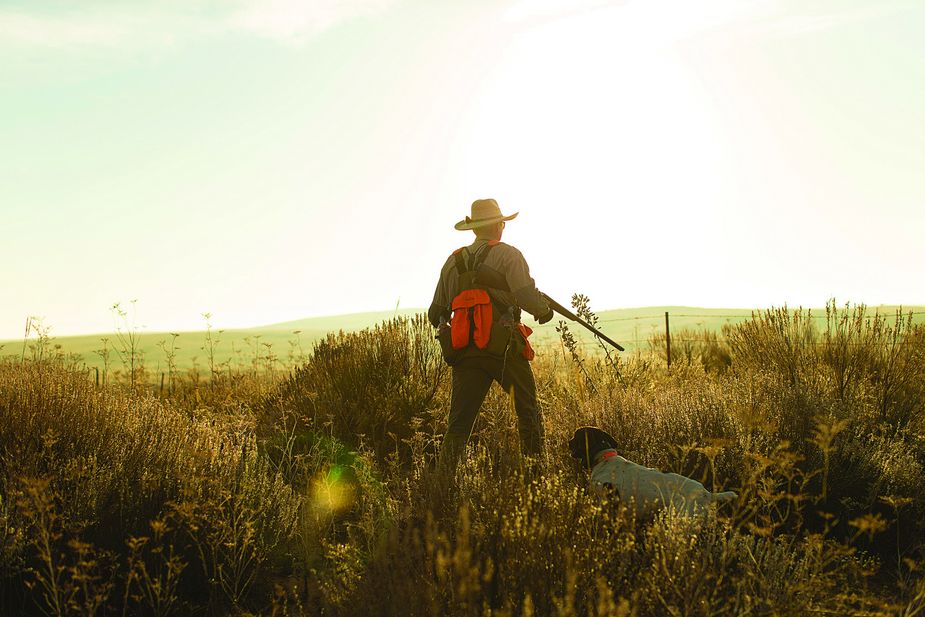
Man and dog set off on an autumn quail hunt at the Cimarron Hills Wildlife Management Area near Freedom.
You breathe deeply of that crisp air and forget all the troubles of the past year as you whistle them on, driving them deeper and deeper into the cover and out of sight. Then you settle in at your pace and follow. You sing out to them occasionally—not to bring them to you but so they might triangulate your location in this world and work to the front in a symbiotic relationship dating to the first scraps of food thrown to a wolf from the edge of a fire. The breeze blows, and you might carry on quiet conversations as you walk either with your hunting party or with the man inside your own head.
Just as things resign themselves to a syncopated rhythm of boots and oiled-canvas chaps swishing through the grass, you top a hill and see him standing. Head high. Tail erect. The light filtering through the edges of his coat. The pride he has in his find can be seen from the horizon, and he beckons to you. You quicken your pace. When you arrive at his outpost, you reach for the heavy shot shells in your pocket as you speak to him softly, reassuring his psyche while praying he remains steady, his nostrils flared and drawing deeply of the scent. As you step in front of him, the birds erupt in a mass exodus of flight. You shoulder the gun, but you are already outwitted. Struggling to pick just a single bird to track with the end of the gleaming barrels, in the end, you pull the trigger while knowing that you’ve lost this match. But there will be others—or so you hope. You turn, and there he stands. Ever faithful, even in your blunder.
At the end of the day, your gloved hand holds his weary head, thanking him for his work. The flick of a wrist and the pat of a head telegraph mutual understanding in an instant.
We are machines in our pursuit, and as the season stretches on, both men and dogs become leaner. Legs grow longer; bellies smaller. Blood pressures fall. We soon are able to easily cover double-digit miles across the prairie together in search of a handful of feathers. We again become one with the land, each footfall informing the next. We are reborn of our forefathers, explorers of the natural world around us. Towed across the landscape by an invisible bond to a canine that so many will never understand.