Farm and Away
Published October 2025
By Sheilah Bright | 16 min read
At seventy-two years old, The Homestead Family Restaurant is Payne County’s oldest restaurant. So it’s appropriate that the walls of this Cushing eatery are lined with black-and-white photos. Between bites of homestyle dishes from taco salads to omelets, diners can peruse the history of this place. Those who look closely might see a familiar historic face: Here’s then-Vice President Harry S. Truman in monochrome memory, seated at a table with a couple of young Oklahoma boys—members of the Future Farmers of America.
One of the boys at the table with Truman is Oliver Kinzie, a Cushing native who combined his family’s dairy heritage with the lessons he learned in FFA to create three businesses—a dairy, then a soft-serve ice cream operation, then three family restaurants that still are open today.
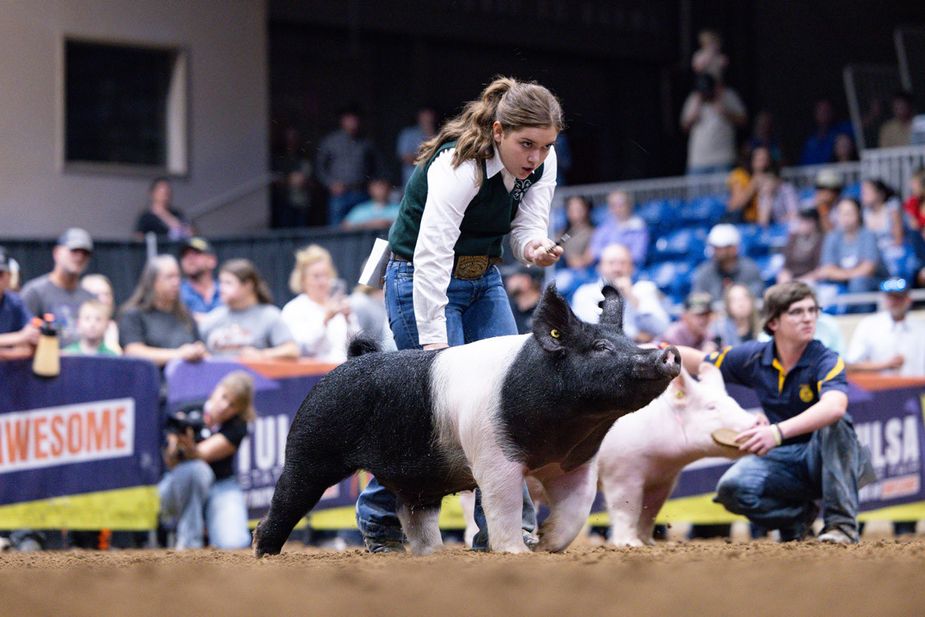
FFA livestock shows are staple events at the Oklahoma and Tulsa State Fairs. Photo courtesy Next Level Images / Tulsa State Fair
“My grandpa was never one to brag about things like meeting President Truman, but he always credited FFA for his success and supported the organization throughout the years,” says Oliver’s grandson Jason Kinzie, who now oversees the family’s Steer Inn Restaurant and Homestead Family Restaurant in Cushing. “He worked until his early eighties. His morals, his work ethic, and his leadership came from his FFA experience, I think.”
Jason and his sister Macy Hollingshead—along with her husband Blake—run the family’s restaurants now. They watched their grandfather step in when a local kid needed help buying a show animal or an FFA jacket. He judged competitions throughout his life. And his family’s restaurants still carry on the tradition of supporting the program that started it all.
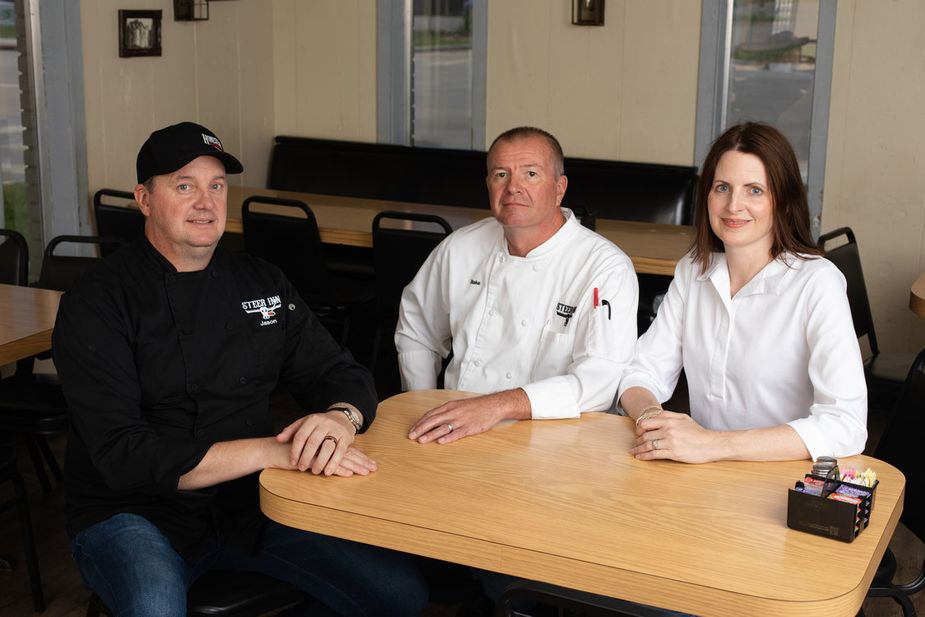
Jason Kinzie, Blake Hollingshead, and Macy Hollingshead at the Homestead Family Restaurant in Cushing. Photo by Brent Fuchs
Cooper Kline’s schedule was not your typical high schooler’s. Every morning, he’d rise early, feed and care for his pigs, then drive thirty minutes to Shawnee for school. After school, he’d drive home or to FFA events then back home any time between eight and midnight to check on his pigs again.
Sixty-five years after Oliver Kinzie started his businesses through FFA, Cooper Kline started his own: Kline Swine. He was an eighth grader in Shawnee’s North Rock Creek High FFA program at the time, and he spent his high school years raising show pigs for competitions, managing a growing operation, competing in FFA events, campaigning for state FFA office—and being a full-time student on top of it all.
“I may have lost a few hours of sleep, but the experience and knowledge I gained was worth it,” Kline says.
He graduated high school in May 2024 and earned enough scholarships to pay for two years at Oklahoma State. With a declared minor in lobbying and campaign management and a major in agricultural education, he hopes to teach ag before possibly moving into a policy-related role to advocate for Oklahoma’s agricultural producers. For the coming year, he’s serving as Oklahoma FFA President—a post held by a college sophomore who previously held state office—during the state chapter’s centennial year.
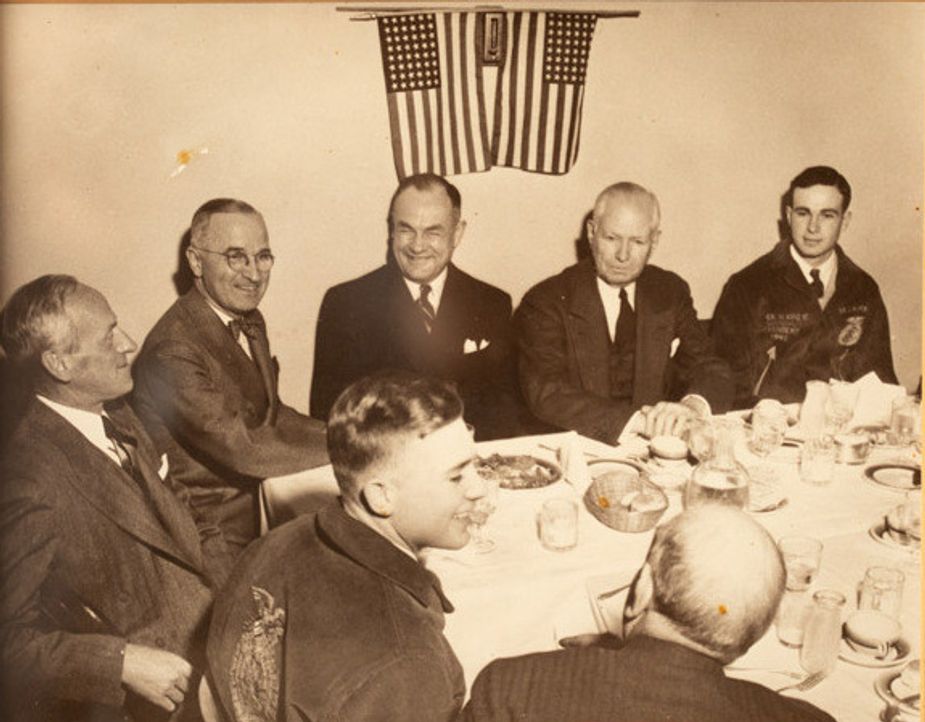
Then-Vice President Harry S. Truman dines with young FFA students, including Oliver Kinzie on the far right.
“I credit this organization for changing my life from my business to my interest in public speaking,” he says. “I came in as a shy eighth grader, and FFA was another avenue for showing livestock like I did in 4-H. But my perspective really shifted. FFA teaches kids about leadership. It gives you a jump-start on the career of your choice.”
Kline Swine expects to produce up to two hundred show pigs for student projects next year. With each sale, Kline offers advice on the pigs’ health and general FFA tips. He never grows tired of sending students videos of their competitions. Though it’s just him on the payroll, he’s got some help.
“I have some great experienced older interns: my parents,” he laughs.
It’d be impossible to pinpoint how many Oklahoma businesses grew their roots from FFA’s supervised agricultural experience projects, or SAEs. Horticulture studies launch landscaping businesses. Welding training fabricates manufacturing opportunities. Leadership training creates business and community advocates. And extemporaneous speech competitions inspire political careers. The state’s FFA roster of alumni includes the late congressman Wes Watkins, Oklahoma Supreme Court Justice Travis Jett, social media influencer and rancher Gatlin Didier, and singer-songwriter Wyatt Flores.
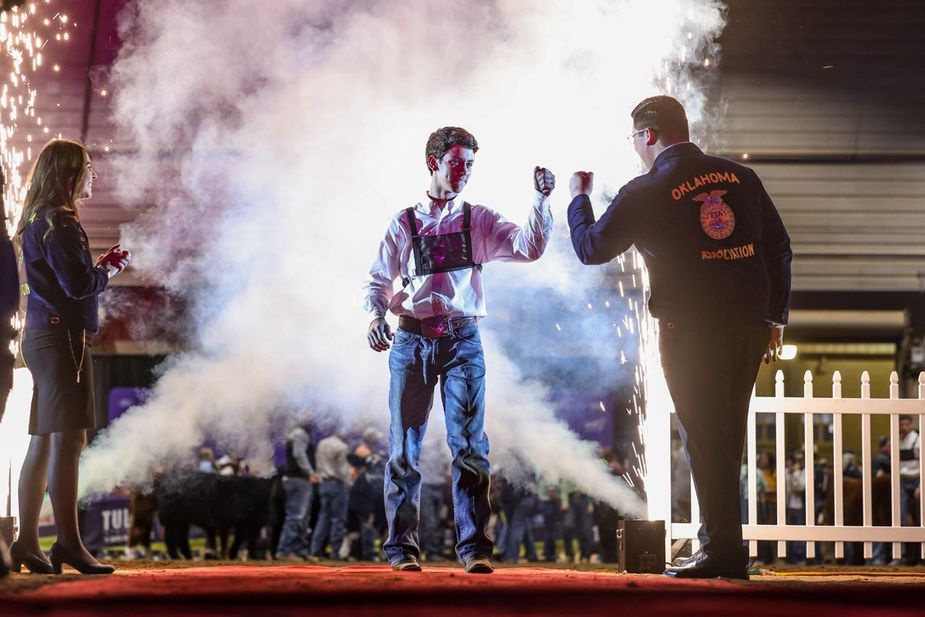
Cooper Kline, right, bumps fists with Kelton Arthur, a fellow Oklahoma FFAer, at the 2024 Tulsa State Fair Livestock Exhibitors Night of Champions, an event that honors 150 4-H and FFA students from around the state. Photo courtesy Next Level Images / Tulsa State Fair
It all started at the 1926 Oklahoma State Fair. Some Oklahoma farm boys walked through the livestock barns and crop exhibits and emerged with a big idea: to raise something that could withstand the constant windstorms, wars, and societal shifts that batter the ever-changing world of agriculture.
The Farm Boys’ Country Life Achievement Club, founded that year, united a handful of “corn” and “Aggie” clubs across the state into one organization before linking up with the Future Farmers of America in 1927.
“We are actually celebrating our hundredth year two years before the national FFA, which chartered in 1928,” says Trevor Lucas, state FFA executive secretary. “We are lucky in Oklahoma, because we are a state agency. Our founding fathers were smart in creating a separate vocational entity. There’s always been a lot of support for ag education in our state.”
Today, Oklahoma has 369 programs in all seventy-seven counties, and eight Oklahomans have served as national FFA presidents. Though originally known as Future Farmers of America, the national organization actually changed its name in 1988 to the National FFA Organization, reflecting a broader scope of agricultural fields in addition to traditional farming and ranching. Today, the organization boasts 29,507 members in Oklahoma and more than a million nationally.
“Our participation levels are as high as they’ve ever been,” says Lucas. “In today’s world, with social media and everything at your fingertips, it might surprise people that students really appreciate hands-on experiences.”
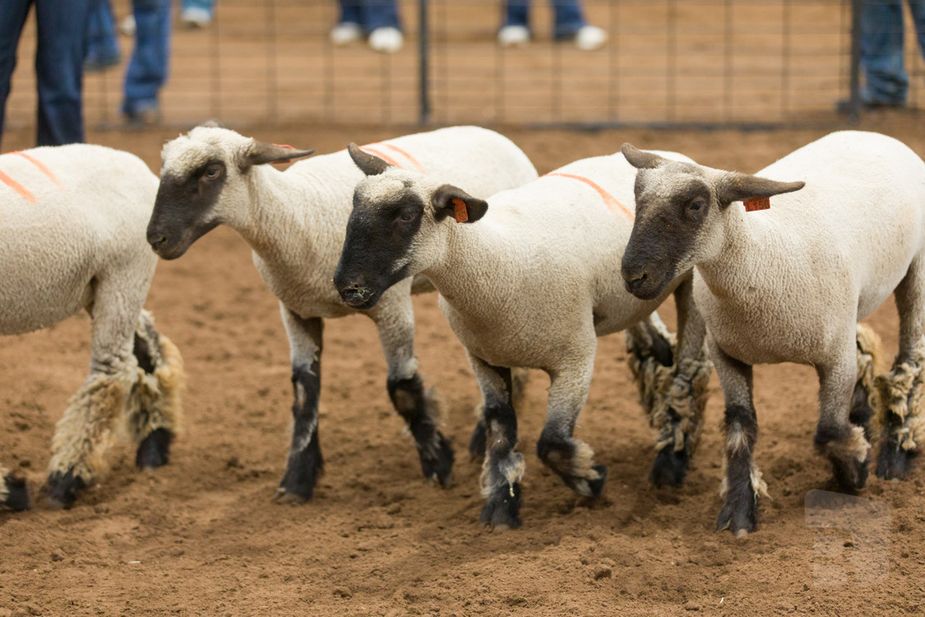
The Oklahoma State Fair in Oklahoma City hosts annual 4-H and FFA events, from livestock competitions to vegetable and fruit exhibits. Photo by Brent Fuchs
In today’s FFA, plant and animal science, food research, and agricultural economics guide students through technology and business education in both classroom and lab settings. Rural and urban students alike come to Oklahoma FFA projects through an elective course now available as early as seventh grade in some school systems. Many districts even have FFA farms, allowing even more students to participate across a wider range of interests. It’s not unusual for students to compete in several programs at the same time, from livestock judging to auctioneering to agronomy.
Haleigh Holt, a junior at Sand Springs High School, began her FFA career showing goats and swine, but soon, she found another favorite activity: skeet shooting.
“I actually transferred to Sand Springs because I heard they had a competitive skeet shooting program,” Holt says. “I competed in the junior world championships and plan to go back to the world championships.”
Holt says FFA offers learning opportunities for students whether they’re what she calls “boots and jeans kids” or just want to explore career opportunities with leadership and speech training. One of her classmates came in with scant agricultural knowledge, thinking chickens gave live birth. After some lighthearted teasing, the class decided to turn the goof into a living lesson and began incubating eggs. Lucas sees opportunities like this as an example of the way FFA students are often at the forefront among their peers, their curiosity and enthusiasm sparked by learning how technology can improve agribusiness.
“The things that can be done now with artificial intelligence and gene editing are amazing, but the human element of always having people involved isn’t going to change,” he says. “Agriculture will always be important. We are always going to have to find a way to feed people.”
One of FFA’s most impactful life lessons comes after all the ribbons and accolades, when it’s time to sell or butcher animal projects. Learning where food comes from also means letting go, says instructor Julie Branen.
“I grew up on my grandparents’ cattle operation and loved FFA,” she says. “I went to college determined to teach some of the lessons that were important in my own life.”
Branen says those lessons include the life cycle—not to mention the hard work and difficult decisions it takes to put food on the table. Branen left Sand Springs this year to go to Bartlesville, where she’s leading that school’s FFA expansion into seventh grade. When one of her students decides to raise a goat, chicken, sheep, cow, or pig, she makes sure there is a clear conversation about the animal’s purpose.
“We talk about it a lot with respect,” she says. “I reinforce that these animals do serve a purpose. They’re not just pets. This is how we get our food. And there are tears sometimes. We understand that and try to meet them where they are. I understand all the emotion and inspiration that comes with being an FFA kid.”
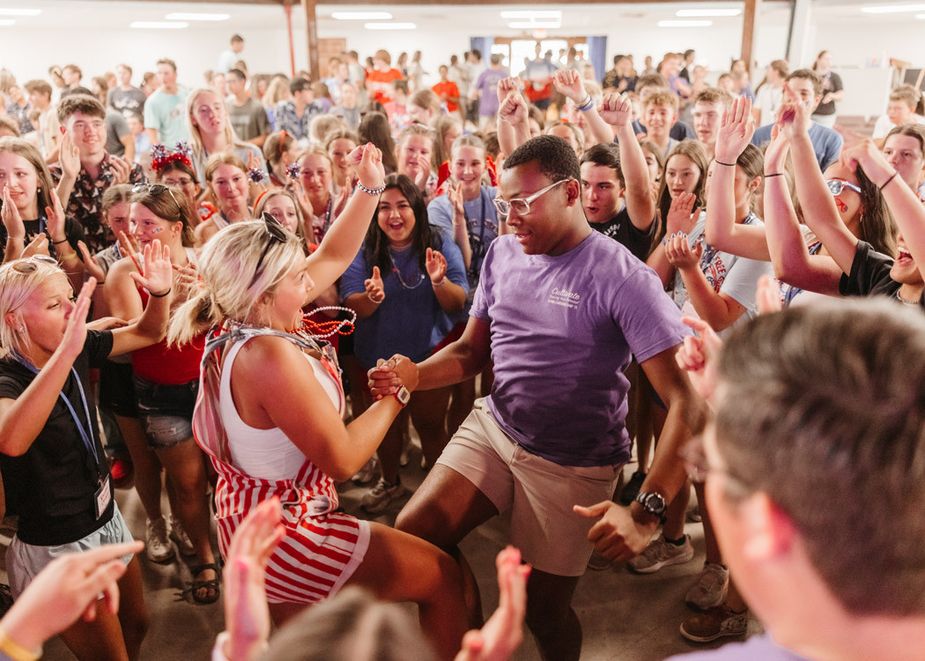
Campers participate in a variety of team-building exercises and other fun activities during their time at the annual Oklahoma FFA Alumni Leadership Camp at Camp Tulakogee in Wagoner. Photo courtesy Griffie Dee Photography
Every spring, 14,000 people, many wearing FFA’s signature blue and gold corduroy jackets, roll into Tulsa’s BOK Center and Arvest Convention Center for the two-day FFA state conference, which organizers believe is the largest annual convention in the state. Food trucks line the street, a music and laser-light show floods the arenas, and a special language lovingly referred to as the “FFA voice” seasons the conversations. Vendors inside offer everything from cowboy hats to college curricula and job opportunities.
“We hear comments all the time from folks who want our students as employees because of their work ethic,” says Scott Nemecek, state FFA advisor and state program manager of CareerTech’s agriculture education. “We teach a lot of central skills: Show up to work on time, look folks in the eye, be accountable, and maintain high character. Those kinds of things translate regardless of the industry.”
That’s why so many Oklahoma businesses remain involved with FFA through support and recruitment efforts. Devon Energy, Oklahoma Ford Dealers, Oklahoma Kubota Dealers, and Oklahoma Farm Bureau were among this year’s high-level state convention sponsors.
In the expo hall, booths staffed by businesses and college representatives offer students information about project support and employment opportunities. Nemecek, who has been involved with Oklahoma FFA for almost fifty of its hundred years as an instructor, sees alumni support, community and business involvement, and legislative support as key to the organization’s longevity and success.
So what will FFA’s next hundred years look like? Program leaders remain optimistic, excited, and curious.
“My grandfather used to have a lot of old farm implements from the 1930s and ’40s in his yard, because he sold tractors,” says Lucas. “I heard he used to tell people that technology had reached its peak with the 1940s tractor. He thought farming wasn’t going to get any better than that. It’s hard to imagine what agribusiness looks like in the future.”
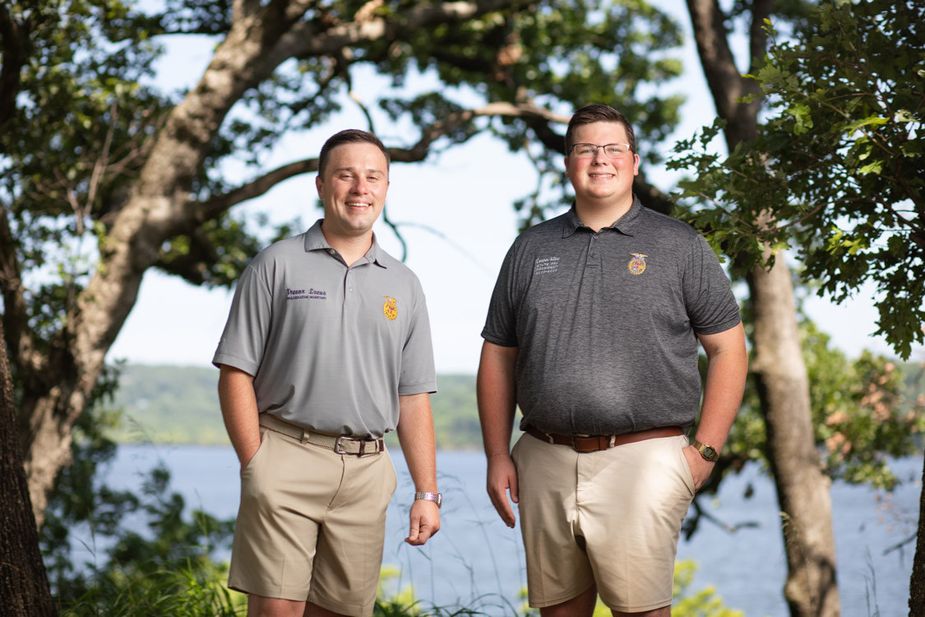
FFA executive secretary Trevor Lucas and president Cooper Kline attended the 2025 FFA Alumni Leadership Camp on Fort Gibson Lake. Photo by Brent Fuchs
To be sure, tractors, technology, and trends will change in the next hundred years. But Oklahoma’s FFA is confident it can meet all challenges and changes, because its roots run as deep as its motto: “Learning to do, doing to learn, earning to live, and living to serve.”
Nothing could be more Oklahoma than that.